
A boutique real estate brand with a working digital engine — built for the market that portals forgot.
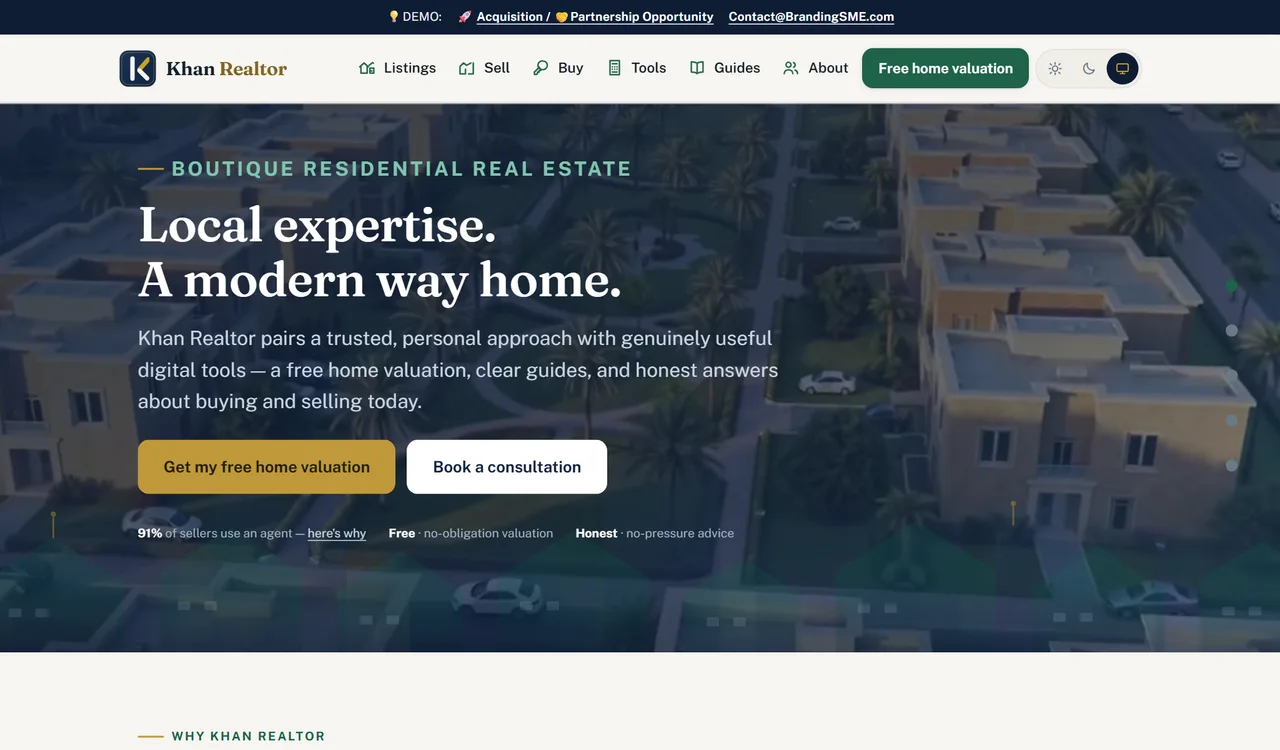
Khan Realtor pairs an exact-match agent brand with a lead-generation platform — free valuation funnel, six calculators, sourced market content — in a ~$1.7 trillion transaction market where 88–91% of movers still hire an agent.
Status: working demonstration built — full site live in previewEvery figure below is sourced & dated (see sources & method)
Opportunity at a glance
Five facts, each sourced
Why this domain
An exact-match brand a stranger can spell, say, and trust
Assessment
- Says the business: surname + category — "Khan" is among the world's most common surnames, and "realtor" is the customer's own word for the service.
- Easy to say and spell: 13 characters, two familiar English words, no hyphens or digits.
- Extension trust: .com remains the default a customer types and trusts for a licensed professional.
- Brandable and extendable: the name scales from one agent to a team and into adjacent services without renaming.
- Personal-brand fit: surname domains are the proven pattern for agent brands — referrals remember a name, then find the site.
Checks & comparables (context, not a valuation)
| Domain status | Unregistered before this build (checked 2026-09-23) |
| Social handles | Probed 2026-09-24 — indicative only; confirm manually per platform before any claim |
| Comparable tier | Two-word .coms are the largest brandable sales category (NameBio; NamePros analysis of the $30k+ tier) |
| Trademark | No ownership or exclusivity claimed; verification required before any transaction |
Comparable-sales context: NameBio (public database of 6.8M+ reported domain sales) and NamePros analyses of two-word .com sales. Public comps skew high and are not a valuation of this domain.
Why now
A $1.7 trillion market at its least competitive moment in decades
Why now
- Total vs reachable: the $1.7T national market is not the claim — one metro's share is. A single mid-size metro runs thousands of transactions a year; reaching 1-in-100 of them is the entire launch business.
- Behavioural tailwind: 52% of buyers found their home online and 70% searched on a phone — the digital front door decides who gets the call.
- Regulatory tailwind: the 2024 commission changes created a content vacuum — plain-language guidance is now a differentiator, and few agent sites have built it.
- Economic tailwind: volumes at 30-year lows mean portals and platform vendors deliver less for agents — an asset-light brand with owned tools costs ~$59–$500+/mo less than the alternatives (vendor pricing, 2026).
Sources: NAR annual reports; Zillow-published Zestimate error rates; NAR 2025 Profile of Home Buyers and Sellers; vendor pricing pages (accessed 2026-09-23/24). Full list in sources & method.
The problem
Everyone moves. Nobody trusts the process.
"What is my home worth — and who is telling me the truth?"
The first question every seller asks is answered worst by the tools they start with: automated off-market estimates carry a ~7% median error. A wrong number costs tens of thousands at the negotiation table.
"The rules changed and nobody explained them to me."
Since August 2024, buyer-agent fees are negotiated in writing before touring. Buyers face new paperwork and new decisions — and most agent sites haven't explained any of it.
"Platform rent is $700–$6,000 a year and the site still looks like everyone else's."
Template platforms (Placester ~$59/mo to Luxury Presence ~$500+/mo) rent generic sites back to agents. Owning a distinctive, fast, tool-rich site converts that rent into an asset.
The product
Built. Working. Demonstrable end to end.
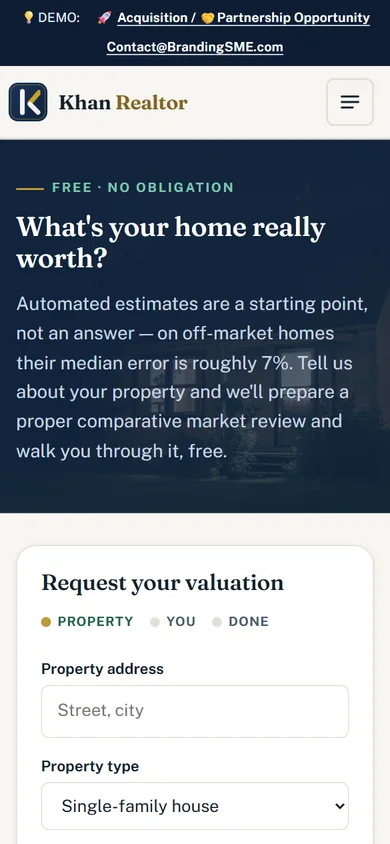
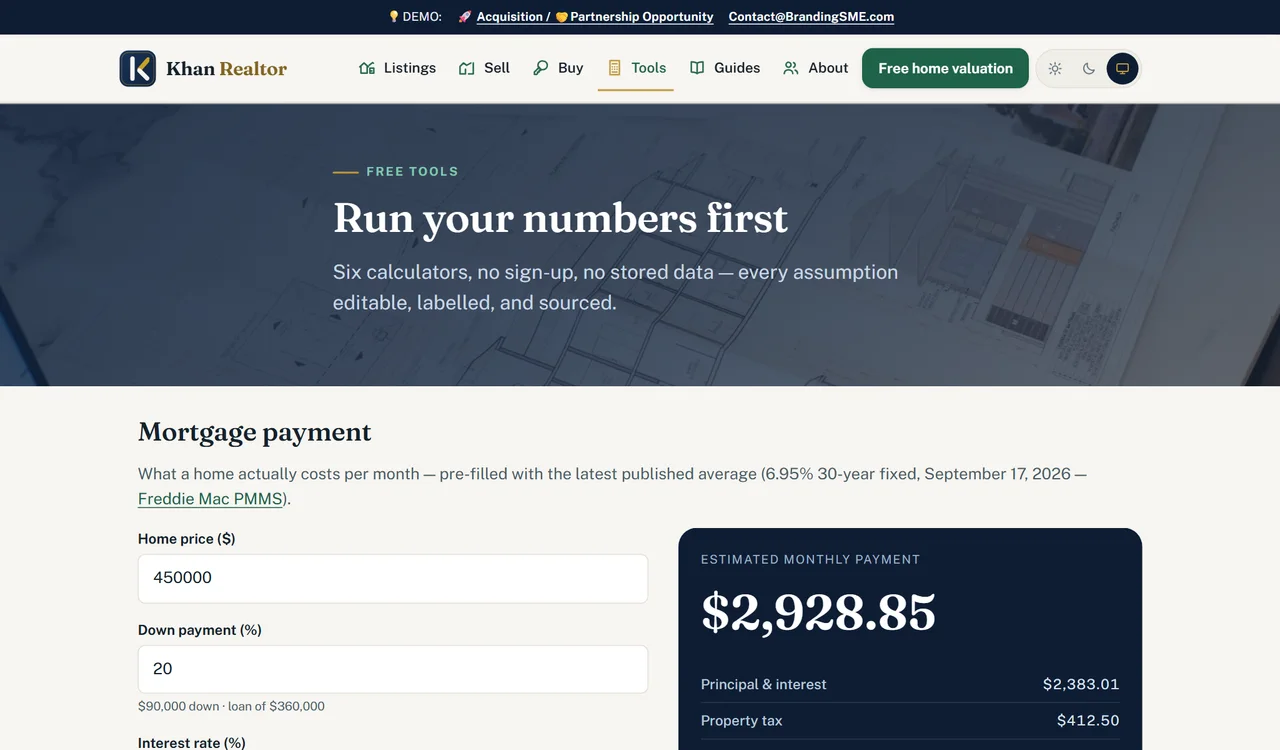
The signature experience is the free valuation funnel: two minutes of inputs, an honest handoff (the site never claims receipt it cannot verify), and a human comparative market review on the other side. Around it: a six-calculator tool suite with sourced assumptions, sourced guides, a listings standard, and a market-report engine.
Honest by construction
- Forms never claim receipt they cannot verify
- Sample listings are labelled "Illustrative"
- Every statistic carries a source and date
- Calculator math is unit-tested to the cent
Operational today: the site, funnels, tools, and content. Sample-labelled: the six showcase listings. Pending operator input: license identity, service area, and live inbox delivery.
Differentiation
Positioned where portals and platforms aren't
| Criterion | Portals (Zillow) | Platforms (Real Geeks etc.) | Template sites | Khan Realtor |
|---|---|---|---|---|
| Who owns the brand | The portal | Shared | Agent (rented look) | The brand, outright |
| Annual cost | Lead fees (auction) | ~$4,800+/yr | ~$700–$1,800/yr | ~$120/yr hosting |
| Honest valuation story | Algorithm (~7% off-market error) | Widget | Widget | Human CMA + published error context |
| Sourced content engine | No (ads-first) | Generic feed | Rarely | Yes — tested, cited, dated |
| Design distinctiveness | Portal-standard | Template | Template | Custom design system |
Win themes: honesty as product (sourced numbers, labelled samples), tools that work before you ever sign up, and a brand a referral remembers.Defensibility (planned, not claimed): accumulated local content and search position, the referral brand itself, and partnerships — none exist at scale yet, and none are claimed as traction.
Business model & scenarios
Commission-per-transaction, asset-light by design
Revenue follows closed transactions: listing-side and buyer-side commissions, negotiated per engagement and disclosed in writing. National context: total commission averages ~5.5–5.7%, buyer-agent share ~2.4–2.8% (Redfin Q3 2025; Bankrate May 2026). No prices are published; each engagement is quoted individually. Operating costs are deliberately near-zero at launch — hosting only — with optional spends (IDX, valuation API, local ads) gated on evidence.
| Assumption | Conservative | Base | Optimistic |
|---|---|---|---|
| Closings per quarter | 1 | 2 | 4 |
| Commission per side (negotiated) | 2.5% | 2.6% | 2.7% |
| Gross annual (sides × price × rate) | $50,000 | $104,000 | $216,000 |
| Platform cost avoided vs Real Geeks-tier | ≈$4,700/yr | ≈$4,700/yr | ≈$4,700/yr |
| Depends on | Operator licensed + active | + referral engine working | + local content ranking + partner referrals |
Roadmap
From launch edition to operating brand
Launch edition (built)
- Brand, identity, design system
- Valuation + booking funnels
- 6 calculators, guides, market report
- Listing showcase standard
Operating brand
- Licensed operator & metro announced
- First real CMA requests handled
- Local neighbourhood editions
- Analytics live; experiments running
Growth
- Live curated/IDX inventory
- Instant-estimate API within quota
- Team or partner build-out
- Additional-language editions
What you get
What each audience gains
📈 Investors
The upside thesis is share of a referral-driven segment in one metro, on near-zero fixed cost. New capital (or capital-in-kind) would unlock, in order: the licensed operator partnership, local content production, IDX/data feeds, and measured local marketing. No round is open; no terms or returns are offered here.
🤝 Partners
Lenders, inspectors, attorneys, stagers, and relocation services reach the same home-mover audience at the exact decision moment: co-branded guides, calculator placements, and vetted referral slots on the tools and valuation pages — integrated into the content engine, not banner ads.
📣 Acquirers
What an acquisition could include — all of it exists: the khanrealtor.com domain (subject to transfer verification), the complete codebase and CI, the design system and original brand assets, the content library, and the research file. Brokerage licenses, books of business, and teams are not included — none exist.
Read this part too
Risks, mitigations, and the tests that settle them
- Operator dependency (largest gate). The brand needs a licensed agent to serve customers. Mitigation: funnels work without one and no operational claims are published. Next test: operator partnership confirmed — everything else is staged behind it.
- Demand unproven. The funnel is built; nobody has filled it in yet. Mitigation: referral-first distribution costs nothing. Next test: ≥10 valuation requests from 50 qualified visits (the Command 10 experiment design).
- Market cyclicality. Volumes are at 30-year lows; commissions track the economy. Mitigation: no fixed costs, no leverage — the model survives low-volume years.
- Competition. Portals own generic search; platforms own agent tooling. Mitigation: local, referral-led positioning plus owned content — not a portal war.
- Regulatory. Agent advertising is state-regulated; commission practices are under settlement scrutiny. Mitigation: no license claims published until verified; investment language kept to an invitation to enquire, flagged for professional review.
Start the conversation
One email, routed by your subject line. We reply to every serious enquiry.
Sources & method
Every figure, with its origin
- National Association of REALTORS®, Profile of Home Buyers and Sellers 2025 (survey year Jul 2024–Jun 2025) — agent usage (88%/91%), referral share (43%), online/mobile search (52%/70%). nar.realtor
- NAR existing-home sales reporting — 4.06M sales in 2025; 2021–2024 annual totals; record median prices. nar.realtor (accessed 2026-09-24)
- Method (derived figure): $1.7T ≈ 4.06M transactions × ~$415K median price — an order-of-magnitude estimate, not a measured total; median ≠ mean, so the true value differs.
- Zillow-published Zestimate median error rates — ~1.9% on-market, ~7.0–7.5% off-market (third-party citations of data refreshed Jun 2026). zillow.com
- Redfin buyer-agent commission data (2.42%, Q3 2025); Bankrate commission survey (~5.7% total / 2.82% buyer-side, May 2026). redfin.com; bankrate.com
- Freddie Mac Primary Mortgage Market Survey — 6.95% 30-yr fixed (Sep 17, 2026). freddiemac.com/pmms
- Platform pricing context — Placester (~$59/mo), Real Geeks (~$399/mo + setup), Luxury Presence (~$500/mo+): vendor pages and HousingWire 2026 roundup.
- NAR settlement practice changes (Aug 2024) and CFPB Closing Disclosure rules (Reg Z §1026.38). nar.realtor/the-facts; consumerfinance.gov
- Domain comparables context — NameBio public sales database (6.8M+ records); NamePros two-word .com tier analyses. namebio.com; namepros.com
This page is a demonstration build's opportunity overview — it is not an offer of securities, and no statement on it is a promise of returns. Projections are labelled as such with visible assumptions. Investment language may be regulated as a financial promotion in some jurisdictions; owner and professional review are required before any publication to investors.